
2001-01-19
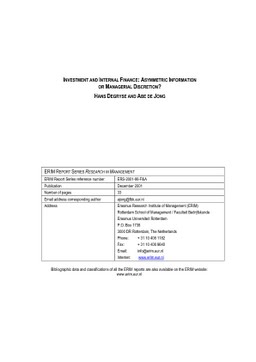
Investment and Internal Finance: Asymmetric Information or Managerial Discretion?
Publication
Publication
This paper examines the relation between cash-flow availability and investment spending in the Netherlands. In particular, we are interested whether managerial discretion and/or asymmetric information drive the positive relation between cash-flow and investment spending. This relation is positive for both firms with low and high investment opportunities. It is however significantly larger for firms with low investment opportunities suggesting that the managerial-discretion problem is most important in the Dutch setting. Effective corporate-governance may reduce this agency problem. Specific to the Netherlands, firms with low shareholder influence posit a higher cash-flow-investment sensitivity. The relevance of asymmetric information is confirmed as smaller firms and firms from information-sensitive industries show a larger cash-flow-investment sensitivity.
| Additional Metadata | |
|---|---|
| , , , , | |
| , , | |
| Erasmus Research Institute of Management | |
| hdl.handle.net/1765/147 | |
| ERIM Report Series Research in Management | |
| Organisation | Erasmus Research Institute of Management |
|
Degryse, H., & de Jong, A. (2001). Investment and Internal Finance: Asymmetric Information or Managerial Discretion? (No. ERS-2001-86-F&A). ERIM Report Series Research in Management. Retrieved from http://hdl.handle.net/1765/147 |
|
| Additional Files | |
|---|---|
| 147_ref.bib Final Version , 12kb | |
| 147.bib Final Version , 274b | |
| dataset Final Version | |