1997-03-19
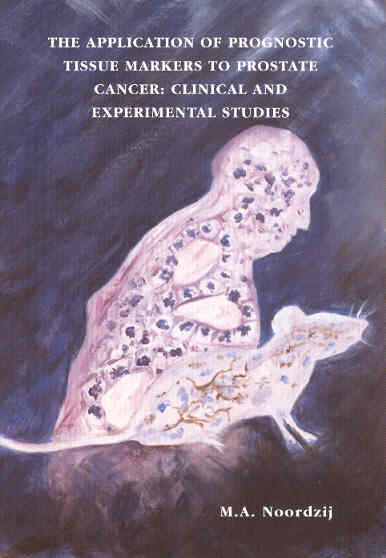
The application of prognostic tissue markers to prostate cancer : clinical and experimental studies
Publication
Publication
De toepassing van prognostische weefsel markers bij prostaat carcinoom: klinische en experimentele studies
The incidence and prevalence of prostate cancer have dramatically increased during the last two decadesl -}. It is now the most prevalent malignant non-skin tumor in the western male population and its mortality is second only to that of lung cancer4• Potosky et at.' studied the incidence of prostate cancer in an analysis covering about 6% of the USA male population. A linear increase was found from 1973 to 1986, which became exponential from 1987 to 1991. The exponential increase can be largely attributed to the introduction of prostate specific antigen (PSA) , transrectal ultrasound (TRUS) and, more recently, to the introduction of population based screening programs as advocated by the American Cancer Society and American Urological Associations.7. However, a very recent study indicates that as from 1991 the age adjusted incidence rate started to decline as fast as it increased before (Figure I.1)'. This is explained by the fact that the application of PSA, TRUS and screening programs enabled the diagnosis of cases that would otherwise have been either diagnosed later or even missed completely. These cases are progressively depleting the population of potential new cases. Consequently, the exponentially rising incidence did not reflect the true incidence and will fall to a new, more realistic steady state. This phenomenon also occurred following the introduction of mammography as a screening test for breast cancer9. The linear increase in age adjusted prostate cancer incidence rates as described above might be caused by changes in risk factors but also by an increased life expectancy. Whether the observed exponential increase is superimposed on a continuing linear trend can only be concluded if a new steady state is reached.
| Additional Metadata | |
|---|---|
| , , , | |
| Stichting Urologische Wetenschappelijk Onderzoek (SUWO)Rotterdam,Stichting Urologie 1973,Hoechst Marion Roussel Nederland bv,YamanouchiNederland bv | |
| F.H. Schröder (Fritz) , Th.H. van der Kwast (Theo) | |
| Erasmus University Rotterdam | |
| hdl.handle.net/1765/18015 | |
| Organisation | Erasmus MC: University Medical Center Rotterdam |
|
Noordzij, M. (1997, March 19). The application of prognostic tissue markers to prostate cancer : clinical and experimental studies. Retrieved from http://hdl.handle.net/1765/18015 |
|

| Additional Files | |
|---|---|
| stellingen noordzij.pdf , 61kb | |
| 1296 NOORDZIJ, Marinus Adrianus.jpg Cover Image , 21kb | |