2004
The efficacy of Tai Chi Chuan in older adults: a systematic review
Publication
Publication
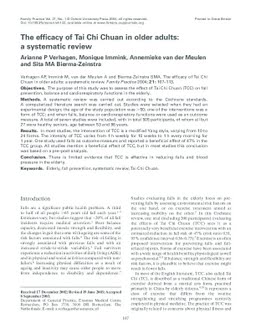
OBJECTIVES: The purpose of this study was to assess the effect of Tai Chi Chuan (TCC) on fall prevention, balance and cardiorespiratory functions in the elderly. METHODS: A systematic review was carried out according to the Cochrane standards. A computerized literature search was carried out. Studies were selected when they had an experimental design; the age of the study population was >50; one of the interventions was a form of TCC; and when falls, balance or cardiorespiratory functions were used as an outcome measure. A total of seven studies were included, with in total 505 participants, of whom all but 27 were healthy seniors, age between 53 and 96 years. RESULTS: In most studies, the intervention of TCC is a modified Yang style, varying from 10 to 24 forms. The intensity of TCC varies from 1 h weekly for 10 weeks to 1 h every morning for 1 year. One study used falls as outcome measure and reported a beneficial effect of 47% in the TCC group. All studies mention a beneficial effect of TCC, but in most studies this conclusion was based on a pre-post analysis. CONCLUSION: There is limited evidence that TCC is effective in reducing falls and blood pressure in the elderly.
| Additional Metadata | |
|---|---|
| , , , , , , , , , , , | |
| hdl.handle.net/1765/10309 | |
| Family Practice: an international journal | |
| Organisation | Erasmus MC: University Medical Center Rotterdam |
|
Verhagen, A., Immink, M., van der Meulen, A., & Bierma-Zeinstra, S. (2004). The efficacy of Tai Chi Chuan in older adults: a systematic review. Family Practice: an international journal. Retrieved from http://hdl.handle.net/1765/10309 |
|