http://hdl.handle.net/1765/1272
isbn: 978-905892-062-1
series: ERIM PhD Series;EPS-2004-038-ORG

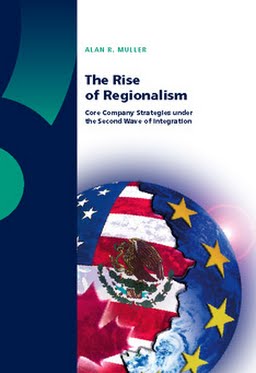
The Rise of Regionalism: Core Company Strategies Under The Second Wave of Integration

(De opkomst van regionalisering: kernondernemingsstrategieën onder de tweede integratiegolf)


Doctoral Thesis
This publication is part of collection
Related Files
asset icon
(EPS2004038ORG_9058920623_MULLER.pdf, 4.1MB)

Regionalisering heeft het multilaterale stelsel ingehaald. Binnen dat kader zijn de gemeenschappelijke markt in Europa (SEM) en de Vrijhandelzone in Noord Amerika (NAFTA) de bi-regionale kern geworden van de mondiale economie. Omdat de onderbouwende beleidsmodellen vrij abstract waren en een vrij eenvoudige benadering van ‘de onderneming’ hebben gebruikt, is nog tien jaar na dato weinig eenduidige conclusies over de betekenis, aard een uitkomst van de ‘tweede regionaliseringsgolf’. Ondernemingen hebben een belangrijke rol gespeeld bij de totstandkoming van regionalisering. Deze veelal grote, machtige ‘kernondernemingen’ leiden internationaliseringsprocessen en hebben een sterke politieke visie. Voor hun is regionalisering hèt institutionele kader waarbinnen zij hun kernstatus en –posities proberen vast te houden. Deze studie, uitgaande van de geografische spreiding van de economische activiteiten van kernondernemingen anno 1990, werpt licht op hun strategische migraties naar aanleiding van regionale integratie. De data laten diverse migraties zien, vooral na 1995, die soms verdere internationalisering inhouden maar ook de-internationalisering, met als uitkomst toenemende polarisering tussen Noord Amerikaanse en Europese kernondernemingen en dus ook een sterk ‘diadiserende’ wereldeconomie met een bi-regionale kern. Alan Muller was born in the United States and attended high school at Garfield High School in Seattle, Washington. He received his undergraduate degree cum laude from the University of Washington’s Department of History in 1993, and participated in an exchange program with the University of Aberdeen, Scotland in 1991-92. Following graduation Alan went to Vienna, Austria as a Fulbright Teaching Assistant, where he assisted English teachers at several high schools while continuing his study in Modern European History. In 1995 he entered a Master’s degree program in International Relations at the University of Amsterdam, graduating cum laude in 1998 with a thesis on ‘Stolper- Samuelson and the Effects of Trade on Mexican Wages’. Alan Muller is currently a researcher at the Erasmus University Rotterdam and research director of the SCOPE Expert Center, through which he has been involved in research projects for inter alia the Dutch Directorate for Development Cooperation and ICCO. His research focuses on company strategies under regional integration, business-government interaction, development issues, bargaining dynamics and international political economy. He has published in the Multinational Business Review and presented numerous papers at academic conferences such as the AIB and AOM annual meetings. At the annual meeting of the European International Business Academy in 2001, he was awarded the 'Most Challenging Thesis Proposal Award' along with a cash prize in recognition of his groundbreaking approach to his PhD research topic.

Regionalism has eclipsed the multilateral system as the 'fast track' for international economic restructuring. Within that framework, the Single European Market (SEM) and North American Free Trade Agreement (NAFTA) have emerged as the bi-polar core of the global economic system. Both agreements employ complex economic models as the basis for projected growth and increased competitive advantage and took a relatively simplistic view of 'the firm'. Partly as a result, ten years into the 'Second Wave' of regionalism there are few uncontested conclusions as to its outcomes or significance.Regional integration has largely been facilitated through the lobby activity of Western 'core companies': large, powerful firms that lead economic restructuring and operate with one foot in the political process. For Western core companies, regionalism has become the institutional framework of choice within which the struggle for the preservation and consolidation of their core positions is played out. Taking their spatial organization of production in 1990 as a baseline, this study is the first to systematically unravel the traditional macro-aggregated understanding of integration outcomes. The evidence shows that, despite the persistence of 'globalization' ideology, regionalism has fueled a diverse pattern of strategic migrations among core companies, particularly since 1995. The outcome is one of growing polarization between North American and European core companies, and consequently within an increasingly dyadic world economy.


Supervisor (promotor):

Prof. Dr. Tulder, R.J.M. van

The author wishes to thank:

Erasmus University Rotterdam, Rotterdam School of Management. Promotor(es):
Prof.dr. R.J.M. van Tulder. Other members:
Prof.dr. S.J. Magala, Prof.dr. P.M.H.H. Matthyssens, Prof.dr. G.C.A. Junne


Keywords


Automatically Extracted Terms
  • company
  • strategy
  • country
  • integration
  • core companies
  • trade
  • market
  • region
  • activity
  • policy
  • european
  • government
  • subsidiary
  • internationalization
  • level
  • production
  • percent
  • value
  • behavior
  • actor