2004-08-06
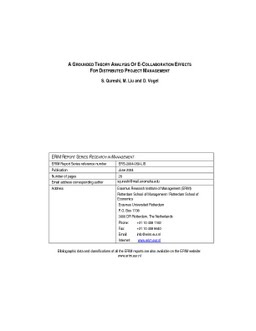
A Grounded Theory Analysis of E-Collaboration Effects for Distributed Project Management
Publication
Publication
The emergence and widespread use of collaborative technologies for distributed project management has brought opened up a myriad of opportunities for business. While the opportunities for off-shore outsourcing and collaborative development are enticing, most tools and techniques for project management focus on on-site, long term relationships and sourcing strategies at a time when inter-organizational relationships are becoming dynamic and temporary. This paper uses grounded theory to analyze data on virtual teams. The analysis uncovers “effects” in the way distributed projects are managed. These effects relate to coordination, communication and adaptation to distributed electronic work environments. Following an analysis of these eCollaboration “effects”, a model for distributed project management is presented.
| Additional Metadata | |
|---|---|
| , , , , | |
| , , , | |
| hdl.handle.net/1765/1448 | |
| ERIM Report Series Research in Management | |
| Organisation | Erasmus Research Institute of Management |
|
Qureshi, S., Liu, M., & Vogel, D. (2004). A Grounded Theory Analysis of E-Collaboration Effects for Distributed Project Management (No. ERS-2004-059-LIS). ERIM Report Series Research in Management. Retrieved from http://hdl.handle.net/1765/1448 |
|