1998-05-20
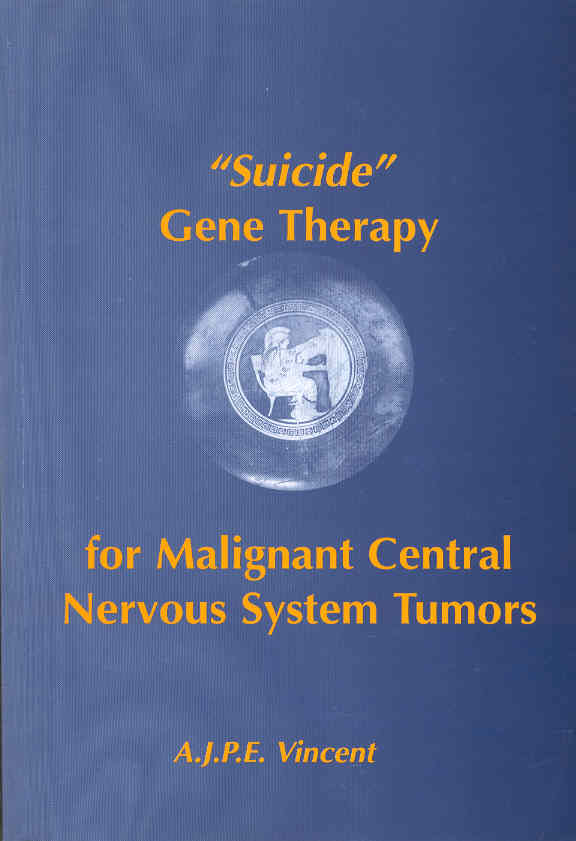
"Suicide" Gen Therapy for Malignant Central Nervous System Tumors
Publication
Publication
"Zelfmoord" Gentherapie voor maligne tumoren van het centrale zenuwstelsel
Despite development in surgical techniques, chemotherapy and radiotherapy, most malignancies of the central nervous system are still devastating tumors with a poor prognosis. For example, median survival of patients with malignant gliomas (astrocytoma, oligodendroglioma or mixed rype) is roughly 12 months and only 5 % of the patients survive more than 5 years after diagnosis. Fifty % of astrocytomas are ryped as glioblastoma multiforme, the most malignant form of glioma. Glioblastoma account for 15-23 % of all intracranial tumors and have a very poor median survival of 6 months with conventional therapy. Metastases account for 15-30 % of all intracranial neoplasm's and develop in 25 to 30 % of all cancer patients. The overall median survival time after surgery followed by radiation therapy in solitary metastatic lesions ranges from 9 to 23 months, depending on the rype of primary cancer. The prognosis in patients with multiple metastases, however, is much worse. Lepto-meningeal metastases from solid tumors are of increasing importance in neuro-oncology, because of the increasing frequency and the severe neurologic disabiliry it causes. About 0.8 to 8 % of patients with cancer develop leptomeningeal metastases and median survival in these patients after radio- and chemotherapy ranges from 7 to 24 weeks.
| Additional Metadata | |
|---|---|
| , , , , | |
| Koningin Wilhelmina Fonds (KWF), Nederlandse Organisatie voor Wetenschappelijk Onderzoek (NWO) | |
| C.J.J. Avezaat (Cees) , D. Valerio (Dinko) | |
| Erasmus University Rotterdam | |
| hdl.handle.net/1765/17653 | |
| Organisation | Erasmus MC: University Medical Center Rotterdam |
|
Vincent, A. (1998, May 20). "Suicide" Gen Therapy for Malignant Central Nervous System Tumors. Retrieved from http://hdl.handle.net/1765/17653 |
|

| Additional Files | |
|---|---|
| color.pdf Final Version , 1mb | |
| Samernvatting.pdf Final Version , 285kb | |
| 1412_VINCENT, Arnoud Jean-Pierre Edouard.jpg Cover Image , 37kb | |