1995-02-22
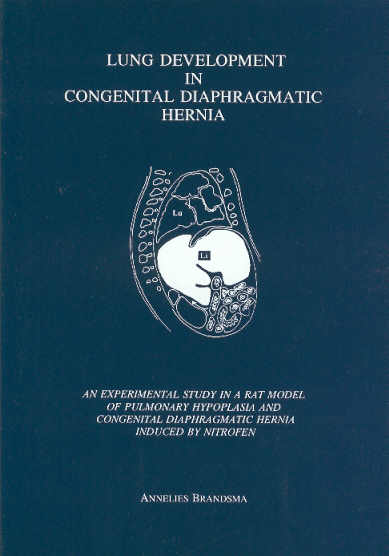
Lung development in congenital diaphragmatic hernia : an experimental study in a rat model of pulmonary hypoplasia and congenital diaphragmatic hernia induced by Nitrofen
Publication
Publication
Longontwikkeling bij congenitale hernia diaphragmatica
Approximately 3% of human neonates are born with one or multiple congenital malformations (Nadler 1986). The birth of a child with a physical or mental handicap presents considerable problems with which both parents and the child must cope and raises questions about the cause. Despite our increasing knowledge of genetics and embryology, many times the answers cannot be given; the etiology of the majority of malformations is still a maze of unknowns (table; McKusick 1992; Wilson 1977).
| Additional Metadata | |
|---|---|
| , , , | |
| Sophia Foundation for Medical Research, Abbott International, Astra Pharmaceutica B.V., Glaxo Pulmonaal, M.A.O.C. Gravin van Bylandt Stichting, Nutricia Nederland, Sandoz B.V. | |
| D. Tibboel (Dick) , A.A.W. ten Have-Opbroek (Ank) | |
| Erasmus University Rotterdam | |
| hdl.handle.net/1765/21465 | |
| Organisation | Erasmus MC: University Medical Center Rotterdam |
|
Brandsma, A. (1995, February 22). Lung development in congenital diaphragmatic hernia : an experimental study in a rat model of pulmonary hypoplasia and congenital diaphragmatic hernia induced by Nitrofen. Retrieved from http://hdl.handle.net/1765/21465 |
|
| Additional Files | |
|---|---|
| stellingen brandsma.pdf , 34kb | |
| 1079_BRANDSMA, Anna Elisabeth.jpg Cover Image , 18kb | |