2010-10-27
Patient-rated health status predicts prognosis following percutaneous coronary intervention with drug-eluting stenting
Publication
Publication
Quality of Life Research p. 1- 9
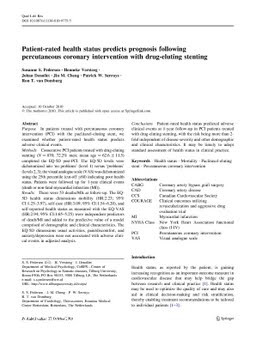
Purpose: In patients treated with percutaneous coronary intervention (PCI) with the paclitaxel-eluting stent, we examined whether patient-rated health status predicts adverse clinical events. Methods: Consecutive PCI patients treated with drug-eluting stenting (N = 870; 72.2% men; mean age = 62.6 ± 11.5) completed the EQ-5D post-PCI. The EQ-5D levels were dichotomized into 'no problems' (level 1) versus 'problems' (levels 2, 3); the visual analogue scale (VAS) was dichotomized using the 25th percentile (cut-off ≤60) indicating poor health status. Patients were followed up for 1-year clinical events (death or non-fatal myocardial infarction (MI)). Results: There were 53 deaths/MIs at follow-up. The EQ-5D health status dimensions mobility (HR:2.23; 95% CI:1.25-3.97), self-care (HR:3.09; 95% CI:1.54-6.20), and self-reported health status as measured with the EQ-VAS (HR:2.94; 95% CI:1.65-5.25) were independent predictors of death/MI and added to the predictive value of a model comprised of demographic and clinical characteristics. The EQ-5D dimensions usual activities, pain/discomfort, and anxiety/depression were not associated with adverse clinical events in adjusted analysis. Conclusions: Patient-rated health status predicted adverse clinical events at 1-year follow-up in PCI patients treated with drug-eluting stenting, with the risk being more than 2-fold independent of disease severity and other demographic and clinical characteristics. It may be timely to adopt standard assessment of health status in clinical practice.
| Additional Metadata | |
|---|---|
| , , , | |
| doi.org/10.1007/s11136-010-9775-5, hdl.handle.net/1765/22146 | |
| Quality of Life Research | |
| Organisation | Erasmus MC: University Medical Center Rotterdam |
|
Pedersen, S., Versteeg, H., Denollet, J., Cheng, J. M., Serruys, P., & van Domburg, R. (2010). Patient-rated health status predicts prognosis following percutaneous coronary intervention with drug-eluting stenting. Quality of Life Research, 1–9. doi:10.1007/s11136-010-9775-5 |
|