1996-03-27
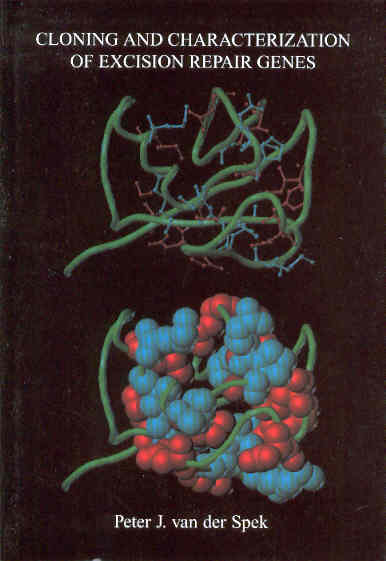
Cloning and characterization of excision repair genes
Publication
Publication
Klonering en karakterisering van excise herstel genen
For all living organisms, it is of vital importance to maintain intact the genetic information stored in the nucleotide sequence of DNA. Numerous environmental and genotoxic agents can affect the DNA and lead to, for example, mutagenesis or carcinogenesis. Study of the mechanism of UV-carcinogenesis has become even more pressing given recent concerns about atmospheric ozone depletion (Mimms, 1994; Watson, 1995), because such atmospheric alterations would result in increased UVB at the earth's surface. Carcinogenesis appears to be a multistep process through which normal cells progress from benign, through transitional stages to the fully malignant forms of cancer by the gradual accumulation of genetic errors (Bishop, 1995). Therefore, normal cells have an intricate quality control mechanism that recognizes and mends damage to the DNA helix.
| Additional Metadata | |
|---|---|
| , , | |
| This project was financially supported by the Medical Genetics Centre and the Dutch CancerSociety. The printing of this thesis was financially supported by: Ames B. V., Autron B. V., BioRadLaboratories B.V., Biozym B.V., Eurogentec N.V., Het Kasteel van Rhoon, PharmaciaB.V., Schleicher & Schuell Nederland B.V. and Thieme's Echte Thee. | |
| D. Bootsma (Dirk) , J.H.J. Hoeijmakers (Jan) | |
| Erasmus University Rotterdam | |
| hdl.handle.net/1765/22432 | |
| Organisation | Erasmus MC: University Medical Center Rotterdam |
|
van der Spek, P. (1996, March 27). Cloning and characterization of excision repair genes. Retrieved from http://hdl.handle.net/1765/22432 |
|
| Additional Files | |
|---|---|
| stellingen vd spek.pdf , 39kb | |
| 1200_Spek, Petrus Johannes van der.jpg Cover Image , 21kb | |