1994-05-25
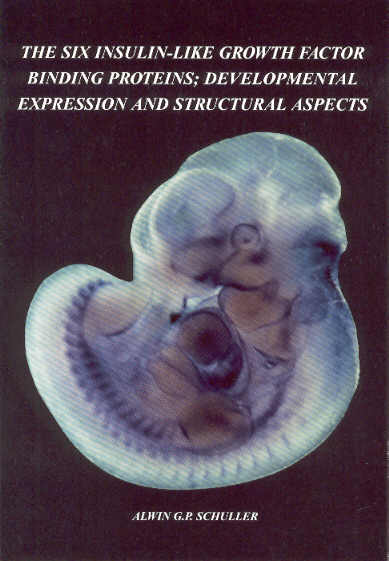
The six insulin-like growth factor binding proteins : developmental expression and structural aspects
Publication
Publication
De zes unsuline-achtige groeifactor bindende eiwitten: expressie tijdens ontwikkeling en structurele aspecten
Insulin-like growth factors (IGF-I and IGF-II) are single chain polypeptides mediating many of the growth promoting effects of growth hormone, as stated in the "somatomedin hypothesis" (Daughaday et al., 1972). IGF-I is a basic protein and consists of 70 AA with a predicted molecular weight of 7.6 kDa. IGF-II is a slightly acidic protein consisting of 67 AA from which 60% are identical to IGF-I. IGF-II has a predicted molecular weight of 7 kDa. Like proinsulin, the IGFs can be divided in a B-domain and an A-domain which are connected by a shott C-domain. Three intrachain disulphide bonds are present in both IGF-I and IGF-II, two between the B and A domains and one within the A domain. Furthermore, a D-domain is found in the IGFs, which is absent in proinsulin. (Rinderknecht and Humbel 1978a, 1978b, Raschdorf et al., 1988). IGF-I and -II carry their names based on the structural and functional homology with insulin (Rinderknecht and Humbe1 1976, Blundell and Humbel 1980, Blundell et al., 1983). Recently, 2-dimensional nuclear magnetic resonance techniques have revealed that the structure of IGF-I in solution is indeed similar to insulin, although some minor differences were observed (Cooke et al., 1991).
| Additional Metadata | |
|---|---|
| , , | |
| Sophia Stichting voar WetenschappeIijk Onderzoek (SSWO), Novo-Nordisk A/S, Denmark | |
| S.L.S. Drop (Stenvert) | |
| Erasmus University Rotterdam | |
| hdl.handle.net/1765/23752 | |
| Organisation | Erasmus MC: University Medical Center Rotterdam |
|
Schuller, A. (1994, May 25). The six insulin-like growth factor binding proteins : developmental expression and structural aspects. Retrieved from http://hdl.handle.net/1765/23752 |
|