2012-09-12
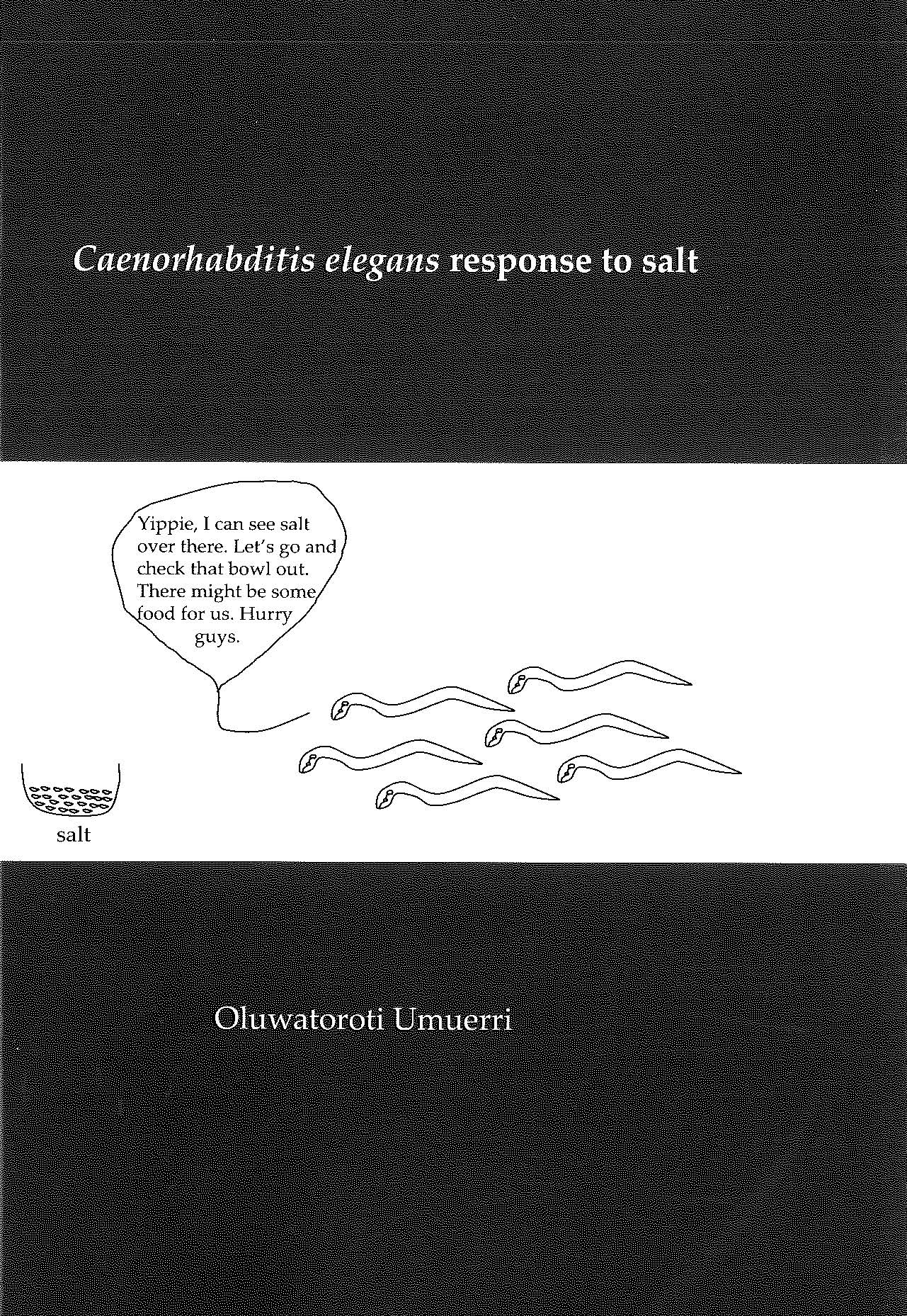
Caenorhabditis elegans response to salt
Publication
Publication
Zout smaak in Caenorhabditis elegans
This thesis describes my work, where I used genetic methods to identify new genes involved in salt taste in C. elegans. In addition, I used calcium imaging to characterize the cellular response of C. elegans to salt. The thesis is divided into five sections and each section is summarized below. In chapter 1, I discuss the importance of salt for our health and subsequently our current knowledge about the different taste modalities and how their sensations are regulated in mammals and Drosophila. Next, I discuss several sensory behaviours of C. elegans and the signal transduction pathways involved, with an emphasis on salt chemotaxis. Furthermore, I discuss different types of learning and memory observed in C. elegans and neurotransmitters involved. Finally, I discuss the importance of C. elegans as a model organism and the behavioural and neuronal methods commonly employed to study C. elegans response to salt.
| Additional Metadata | |
|---|---|
| , , , | |
| The research described in this thesis was financially supported by NWO, Netherlands and the printing of this thesis was partially supported by the J.E. Jurriaanse Stichting | |
| F.G. Grosveld (Frank) | |
| Erasmus University Rotterdam | |
| hdl.handle.net/1765/37357 | |
| Organisation | Erasmus MC: University Medical Center Rotterdam |
|
Umuerri, O. O. (2012, September 12). Caenorhabditis elegans response to salt. Retrieved from http://hdl.handle.net/1765/37357 |
|
| Additional Files | |
|---|---|
| 3578_Umuerri, Oluwatoroti Omowayewa.jpg Cover Image , 782kb | |
| Propositions Umuerri.pdf Final Version , 125kb | |