
2012-09-19
The role of inclusions in ALS pathogenesis
Publication
Publication
De rol van eiwit inclusies in de ALS pathogenese
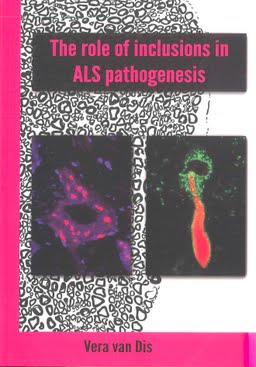
Amyotrophic lateral sclerosis (ALS) is a devastating neurodegenerative disease that primarily afflicts motor neurons, leading to paralysis and death within 3 to 5 years after diagnosis. Genetic studies have uncovered multiple genetic defects causing familial forms of ALS and mutations occurring in proteins with a variety of functions, including RNA metabolism (TDP43, FUS) and oxygen free radical homeostasis (SOD1). A commonality among all ALS forms is the presence of intracellular inclusions that primarily consist of insoluble protein aggregates. These inclusions indicate that protein aggregation is a central pathogenic event shared by multiple ALS forms. The research of the present thesis focuses on the role of protein aggregation and inclusion formation in two types of ALS: 1) ALS caused by mutations in the superoxide dismutase 1 (SOD1) gene (ALS1); and 2) ALS caused by mutations in the vesicle-associated membrane protein (VAMP)-associated protein B (VAPB) gene (ALS8).
| Additional Metadata | |
|---|---|
| , , , , | |
| C.C. Hoogenraad (Casper) , C.I. de Zeeuw (Chris) | |
| Erasmus University Rotterdam | |
| hdl.handle.net/1765/37358 | |
| Organisation | Erasmus MC: University Medical Center Rotterdam |
|
van Dis, V. (2012, September 19). The role of inclusions in ALS pathogenesis. Retrieved from http://hdl.handle.net/1765/37358 |
|
| Additional Files | |
|---|---|
| voorkantje_final.pdf Final Version , 12mb | |
| 3581_Dis, Vera van.jpg Cover Image , 252kb | |
| Stellingen van Dis.pdf , 16kb | |
