1980
Intra aortic balloon pumping in myocardial infarction and unstable angina
Publication
Publication
European Heart Journal , Volume 1 - Issue 1 p. 31- 43
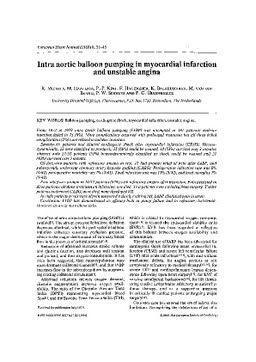
From 1972 to 1979 intra aortic balloon pumping (IABP) was attempted in 181 patients; catheter insertion failed in 13 (8%). More complications occurred with prolonged treatment but all three lethal complications (2%) were related to catheter insertion. Seventy-six patients had clinical cardiogenic shock after myocardial infarction (CSMI). Haemodynamically, 23 were classified as preshock: 15 (66%) could be weaned, 12 (53%) survived over 3 months; whereas only 27/51 patients (51%) haemodynamically classified as shock could be weaned and 21 (40%) survived over 3 months. Of forty-two patients with refractory angina at rest, 41 had prompt relief of pain after IABP, and subsequently underwent coronary artery bypasss grafting (CABG). Perioperative infarction rate was 8% (4/41), perioperative mortality was 7% (3/41). Total infarction rate was 11% (5/42), and total mortality 7% (3/41). Pain relief was prompt in 14/17 patients (82%) with refractory angina after infarction. Pain persisted in three patients: all three sustained an infarction, one died. Two patients were excluded from surgery. Twelve patients underwent CABG; none died, none developed MI. In eight patients persistence of pain suggested a slowly evolving MI, IABP abolished pain in seven. Conclusion: IABP has demonstrated its efficacy both in pump failure and in refractory ischaemia. However, its use is not without risks.
| Additional Metadata | |
|---|---|
| , , , , , , , , , , , , , , , | |
| hdl.handle.net/1765/4023 | |
| European Heart Journal | |
| Organisation | Erasmus MC: University Medical Center Rotterdam |
|
Michels, R., Haalebos, M., Kint, P.-P., Hagemeijer, F., Balakumaran, K., van den Brand, M., … Hugenholtz, P. (1980). Intra aortic balloon pumping in myocardial infarction and unstable angina. European Heart Journal, 1(1), 31–43. Retrieved from http://hdl.handle.net/1765/4023 |
|