2004-08-04
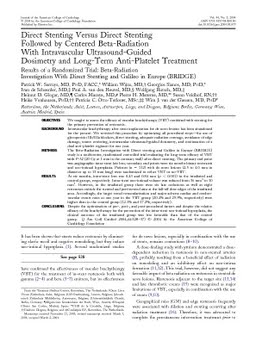
Direct stenting versus direct stenting followed by centered beta-radiation with intravascular ultrasound-guided dosimetry and long-term anti-platelet treatment: results of a randomized trial: Beta-Radiation Investigation with Direct Stenting and Galileo in Europe (BRIDGE).
Publication
Publication
Journal of the American College of Cardiology , Volume 44 - Issue 3 p. 528- 537
Abstract OBJECTIVES: We sought to assess the efficacy of vascular brachytherapy (VBT) combined with stenting for the primary prevention of restenosis. BACKGROUND: Intravascular brachytherapy after stent implantation for de novo lesions has been abandoned for the present. We revisited this procedure by optimizing all procedural steps-the use of glycoprotein IIb/IIa blockers, direct stenting, adequate radiation coverage, avoidance of edge damage, source centering, intravascular ultrasound-guided dosimetry, and continuation of a dual anti-platelet regimen for one year. METHODS: The Beta-Radiation Investigation with Direct stenting and Galileo in Europe (BRIDGE) study is a multicenter, randomized controlled trial evaluating the long-term efficacy of VBT with P-32 (20 Gy at 1 mm in the coronary wall) after direct stenting. The primary end point was angiographic intra-stent late loss; secondary end points were six months binary restenosis and neo-intimal hyperplasia. Patients (n = 112) with de novo lesions (2.5 to 4.0 mm in diameter up to 15 mm long) were randomized to either VBT or no-VBT. RESULTS: At six months, intra-stent loss was 0.43 and 0.84 mm (p < 0.001) in the irradiated and control groups, respectively. Intra-stent neo-intimal volume was reduced from 36 mm3 to 10 mm3. However, in the irradiated group there were six late occlusions as well as eight restenoses outside the stented and peri-stented area at the fall-off dose edges of the irradiated area. Accordingly, the target vessel revascularization and major adverse cardiac and cerebrovascular events rates at one year in the VBT group (20.4% and 25.9%, respectively) were higher than in the control group (12.1% and 17.2%, respectively). CONCLUSIONS: Despite the optimization of pre-, peri-, and post-procedural factors and despite the relative efficacy of the brachytherapy for the prevention of the intra-stent neo-intimal hyperplasia, the clinical outcome of the irradiated group was less favorable than that of the control group.
| Additional Metadata | |
|---|---|
| , , , , , , , , , , , , , , , , , , | |
| doi.org/10.1016/j.jacc.2004.03.077, hdl.handle.net/1765/4648 | |
| Journal of the American College of Cardiology | |
| Organisation | Erasmus MC: University Medical Center Rotterdam |
|
Serruys, P., Wijns, W., Sianos, G., de Scheerder, I., van den Heuvel, P., Rutsch, W., … van der Giessen, W. (2004). Direct stenting versus direct stenting followed by centered beta-radiation with intravascular ultrasound-guided dosimetry and long-term anti-platelet treatment: results of a randomized trial: Beta-Radiation Investigation with Direct Stenting and Galileo in Europe (BRIDGE). Journal of the American College of Cardiology, 44(3), 528–537. doi:10.1016/j.jacc.2004.03.077 |
|