1993
An international randomized trial comparing four thrombolytic strategies for acute myocardial infarction
Publication
Publication
New England Journal of Medicine , Volume 329 - Issue 10 p. 673- 682
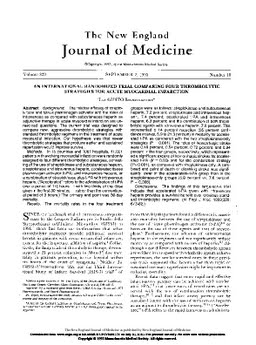
BACKGROUND: The relative efficacy of streptokinase and tissue plasminogen activator and the roles of intravenous as compared with subcutaneous heparin as adjunctive therapy in acute myocardial infarction are unresolved questions. The current trial was designed to compare new, aggressive thrombolytic strategies with standard thrombolytic regimens in the treatment of acute myocardial infarction. Our hypothesis was that newer thrombolytic strategies that produce earlier and sustained reperfusion would improve survival. METHODS: In 15 countries and 1081 hospitals, 41,021 patients with evolving myocardial infarction were randomly assigned to four different thrombolytic strategies, consisting of the use of streptokinase and subcutaneous heparin, streptokinase and intravenous heparin, accelerated tissue plasminogen activator (t-PA) and intravenous heparin, or a combination of streptokinase plus t-PA with intravenous heparin. ("Accelerated" refers to the administration of t-PA over a period of 1 1/2 hours--with two thirds of the dose given in the first 30 minutes--rather than the conventional period of 3 hours.) The primary end point was 30-day mortality. RESULTS: The mortality rates in the four treatment groups were as follows: streptokinase and subcutaneous heparin, 7.2 percent; streptokinase and intravenous heparin, 7.4 percent; accelerated t-PA and intravenous heparin, 6.3 percent, and the combination of both thrombolytic agents with intravenous heparin, 7.0 percent. This represented a 14 percent reduction (95 percent confidence interval, 5.9 to 21.3 percent) in mortality for accelerated t-PA as compared with the two streptokinase-only strategies (P = 0.001). The rates of hemorrhagic stroke were 0.49 percent, 0.54 percent, 0.72 percent, and 0.94 percent in the four groups, respectively, which represented a significant excess of hemorrhagic strokes for accelerated t-PA (P = 0.03) and for the combination strategy (P < 0.001), as compared with streptokinase only. A combined end point of death or disabling stroke was significantly lower in the accelerated-tPA group than in the streptokinase-only groups (6.9 percent vs. 7.8 percent, P = 0.006). CONCLUSIONS: The findings of this large-scale trial indicate that accelerated t-PA given with intravenous heparin provides a survival benefit over previous standard thrombolytic regimens
| Additional Metadata | |
|---|---|
| , , , , , , , , , , , , , , , , , | |
| GUSTO Investigators | |
| doi.org/10.1056/NEJM199309023291001, hdl.handle.net/1765/5468 | |
| New England Journal of Medicine | |
| Organisation | Erasmus MC: University Medical Center Rotterdam |
|
Simoons, M., Topol, E., Califf, R., van de Werf, F., Armstrong, P., Aylward, P. E., … Hampton, J. (1993). An international randomized trial comparing four thrombolytic strategies for acute myocardial infarction. New England Journal of Medicine, 329(10), 673–682. doi:10.1056/NEJM199309023291001 |
|