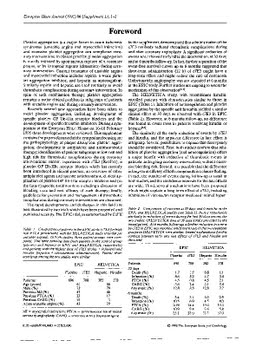
Platelet aggregation is a major factor in acute ischaemic syndromes (unstable angina and myocardial infarction) and excessive platelet aggregation can complicate coro- nary interventions. In clinical practice, platelet aggregation is usually initiated by spontaneous rupture of a coronary plaque, or by iatrogenic rupture (dissection) during coro- nary intervention. Current treatment of unstable angina and myocardial infarction includes aspirin, a weak plate- let aggregation inhibitor, and heparin as anticoagulant. Similarly aspirin and heparin are used routinely to avoid thrombotic complications during coronary intervention. In spite of such combination therapy, platelet aggregation remains a major clinical problem in subgroups of patients with unstable angina and during coronary intervention.
| Additional Metadata | |
|---|---|
| doi.org/10.1093/eurheartj/16.suppl_L.1, hdl.handle.net/1765/5512 | |
| European Heart Journal | |
| Organisation | Erasmus MC: University Medical Center Rotterdam |
|
Simoons, M. (1995). Foreword. European Heart Journal, 16, 1–2. doi:10.1093/eurheartj/16.suppl_L.1 |
|