1995-05-01
Nasal Carriage of Staphylococcus Aureus and Cross-Contamination in a Surgical Intensive Care Unit: Efficacy of Mupirocin Ointment
Publication
Publication
Journal of Hospital Infection , Volume 30 - Issue 1 p. 39- 49
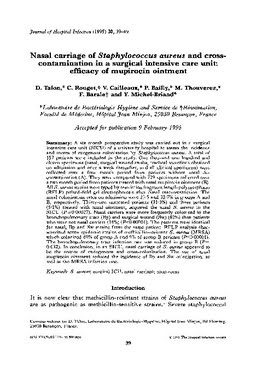
A six month prospective study was carried out in a surgical intensive care unit (SICU) of a university hospital to assess the incidence and routes of exogenous colonization by Staphylococcus aureus. A total of 157 patients were included in the study. One thousand one hundred and eleven specimens (nasal, surgical wound swabs, tracheal secretions obtained on admission and once a week thereafter, and all clinical specimens) were collected over a four month period from patients without nasal decontamination (A). They were compared with 729 specimens collected over a two month period from patients treated with nasal mupirocin ointment (B). All S. aureus strains were typed by restriction fragment length polymorphism (RFLP) pulsed-field gel electrophoresis after SmaI macrorestriction. The nasal colonization rates on admission were 25.5 and 32.7% in groups A and B, respectively. Thirty-one untreated patients (31.3%) and three patients (5.1%) treated with nasal ointment, acquired the nasal S. aureus in the SICU (P = 0.00027). Nasal carriers were more frequently colonized in the bronchopulmonary tract (Bp) and surgical wound (Sw) (62%) than patients who were not nasal carriers (14%) (P < 0.00001). The patterns were identical for nasal, Bp and Sw strains from the same patient. RFLP analysis characterized seven epidemic strains of methicillin-resistant S. aureus (MRSA) which colonized 60% of group A and 9% of group B patients (P < 0.00001). The bronchopulmonary tract infection rate was reduced in group B (P = 0.032). In conclusion, in an SICU, nasal carriage of S. aureus appeared to be the source of endogenous and cross- colonization. The use of nasal mupirocin ointment reduced the incidence of Bp and Sw colonization, as well as the MRSA infection rate.
| Additional Metadata | |
|---|---|
| , , , , , , , , , , , , , , , | |
| hdl.handle.net/1765/6970 | |
| Staphylococcus aureus: Resources | |
| Journal of Hospital Infection | |
| Organisation | Erasmus MC: University Medical Center Rotterdam |
|
Talon, D., Rouget, C., Cailleaux, V., Bailly, P., Thouverez, M., Barale, F., & Michel-Briand, Y. (1995). Nasal Carriage of Staphylococcus Aureus and Cross-Contamination in a Surgical Intensive Care Unit: Efficacy of Mupirocin Ointment. Journal of Hospital Infection, 30(1), 39–49. Retrieved from http://hdl.handle.net/1765/6970 |
|