Understanding Consumer Reactions to Assortment Unavailability
(Een onderzoek naar consumentenreacties ten gevolge van assortimentsafwezigheid)
2006-02-16
Doctoral Thesis
| Related Files |
|---|
|
(EPS20060874MKT_9058921026_SLOOT.pdf, 3.8MB) |
Any regular grocery shopper will be familiar with the annoying situation in which his or her preferred product is not available at the moment (s) he wants to buy it. Assortment unavailability can be temporary (e.g., out-of-stock) or permanent in nature (e.g., assortment reduction). Shopper research shows that the unavailability of products is one of the most significant annoyances for grocery shoppers. This dissertation presents three empirical studies that research consumer reactions to out-of-stock and assortment reduction. Both out-of-stock and assortment reduction lead to consumer complaining behavior, category sales losses and store switching behavior. It is found that consumer reactions to assortment unavailability are mainly related to brand- and product-related antecedents of the item that is not available. Furthermore, the long-term impact of an assortment reduction on category sales differs from the short-term impact. In summary, this dissertation concludes that retailers should be very careful reducing assortments and boycotting brands.
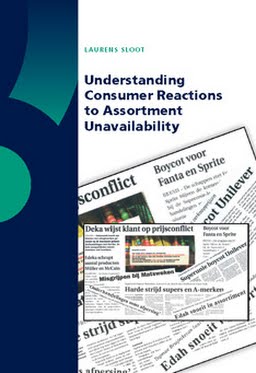
Iedere klant maakt het wel eens mee in de supermarkt: misgrijpen. In sommige gevallen is een product tijdelijk niet beschikbaar, bijvoorbeeld doordat de supermarkt de vraag naar een bepaald artikel onderschat heeft. In andere gevallen is een product voor langere tijd niet beschikbaar, bijvoorbeeld als een retailer besloten heeft een assortiment in te krimpen of een merk te boycotten. Uit consumentenonderzoek blijkt dat out-of-stock en artikelsaneringen hoog op de lijst van consumentenergernissen staan. In dit proefschrift wordt via drie empirische studies onderzocht hoe consumenten reageren in gevallen waar het geprefereerde product niet beschikbaar is. Zowel out-of-stock als assortimentsreducties leiden tot klaaggedrag, lagere categorieverkopen en winkelswitch. Het blijkt dat consumentenreacties ten aanzien van assortimentsafwezigheid voornamelijk samenhangen met merk- en productgerelateerde factoren van het artikel dat niet aanwezig is. Verder blijkt dat de lange termijn gevolgen van assortimentsafwezigheid verschillen van de korte termijn gevolgen. Samengevat blijkt dat retailers voorzichtig te werk moeten gaan bij het saneren van artikelen en het boycotten van merken.
The Erasmus Research Institute of Management (ERIM) is the Research School (Onderzoekschool) in the field of management of the Erasmus University Rotterdam. The founding participants of ERIM are RSM Erasmus University and the Erasmus School of Economics. ERIM was founded in 1999 and is officially accredited by the Royal Netherlands Academy of Arts and Sciences (KNAW). The research undertaken by ERIM is focussed on the management of the firm in its environment, its intra- and inter-firm relations, and its business processes in their interdependent connections. The objective of ERIM is to carry out first rate research in management, and to offer an advanced graduate program in Research in Management. Within ERIM, over two hundred senior researchers and Ph.D. candidates are active in the different research programs. From a variety of academic backgrounds and expertises, the ERIM community is united in striving for excellence and working at the forefront of creating new business knowledge.
Prof. Dr. Verhoef, P.C.
Prof. Dr. Peelen, E.
Prof. Dr. Commandeur, H.R.
Franses, Ph.H.B.F.
Commandeur, H.R.
Dekimpe, M.G.
Verhoef, P.C.
Peelen, E.
Bakker, B.A.
- brand equity
- Retailing
- category management
- brand boycott
- brand delisting
- assortment reduction
- assortment management
- hedonic and utilitarian products
- out-of-stock
- M : Business Administration and Business Economics; Marketing; Accounting
- C44 : Statistical Decision Theory; Operations Research
- M31 : Marketing
- brand
- assortment
- store
- effect
- category
- product
- consumer
- study
- reduction
- level
- retailer
- delisting
- brand equity
- hedonic
- research
- assortment reduction
- equity
- variable
- buyer
- hedonic level