1993
Protein tyrosine phosphorylation is involved in osmoregulation of ionic conductances
Publication
Publication
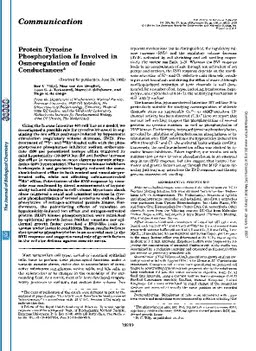
Using the human Intestine 407 cell line as a model, we investigated a possible role for tyrosine kinase(s) in regulating the ion efflux pathways induced by hyposmotic stimulation (regulatory volume decrease, RVD). Pretreatment of 125I(-)-and 86Rb(+)-loaded cells with the phosphotyrosine phosphatase inhibitor sodium orthovanadate (200 microM) potentiated isotope efflux triggered by mild hypotonicity (10-20%) but did not further increase the efflux in response to more vigorous osmotic stimulation (30% hypotonicity). The tyrosine kinase inhibitors herbimycin A and genistein largely reduced the osmoshock-induced efflux in both control and vanadate-pretreated cells, while not affecting calcium-activated 86Rb+ efflux. Potentiation of the RVD response by vanadate was confirmed by direct measurements of hypotonicity-induced changes in cell volume. Hypotonic shock alone triggered a rapid and transient increase in tyrosine phosphorylation of several proteins as well as phosphorylation of mitogen-activated protein kinase. Furthermore, the potentiating effects of vanadate on hypotonicity-induced ion efflux and mitogen-activated protein (MAP) kinase phosphorylation were mimicked by epidermal growth factor. Neither vanadate nor epidermal growth factor provoked a RVD-like ionic response under isotonic conditions. These results indicate that tyrosine phosphorylation is an essential step in the RVD response and suggest a novel role of growth factors in the cellular defense against osmotic stress.
| Additional Metadata | |
|---|---|
| , , , , , , , , , , , , , , , , , , , , , | |
| hdl.handle.net/1765/8548 | |
| Journal of Biological Chemistry | |
| Organisation | Erasmus MC: University Medical Center Rotterdam |
|
Tilly, B., van den Berghe, N., Tertoolen, L. G., Edixhoven, M., & de Jonge, H. (1993). Protein tyrosine phosphorylation is involved in osmoregulation of ionic conductances. Journal of Biological Chemistry. Retrieved from http://hdl.handle.net/1765/8548 |
|