2002
Antibody-mediated enhancement of human immunodeficiency virus type 1 infectivity is determined by the structure of gp120 and depends on modulation of the gp120-CCR5 interaction
Publication
Publication
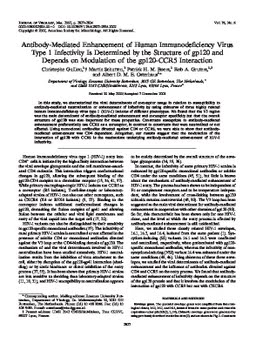
In this study, we characterized the viral determinants of coreceptor usage in relation to susceptibility to antibody-mediated neutralization or enhancement of infectivity by using chimeras of three highly related human immunodeficiency virus type 1 (HIV-1) isolates of different phenotypes. We found that the V3 region was the main determinant of antibody-mediated enhancement and coreceptor specificity but that the overall structure of gp120 was also important for these properties. Constructs susceptible to antibody-mediated enhancement preferentially use CCR5 as a coreceptor, in contrast to constructs that were neutralized or not affected. Using monoclonal antibodies directed against CD4 or CCR5, we were able to show that antibody-mediated enhancement was CD4 dependent. Altogether, our results suggest that the modulation of the interaction of gp120 with CCR5 is the mechanism underlying antibody-mediated enhancement of HIV-1 infectivity.
| Additional Metadata | |
|---|---|
| , , , , , , , , , | |
| hdl.handle.net/1765/9859 | |
| Journal of Virology | |
| Organisation | Erasmus MC: University Medical Center Rotterdam |
|
Guillon, C., Schutten, M., Boers, P., Gruters, R., & Osterhaus, A. (2002). Antibody-mediated enhancement of human immunodeficiency virus type 1 infectivity is determined by the structure of gp120 and depends on modulation of the gp120-CCR5 interaction. Journal of Virology. Retrieved from http://hdl.handle.net/1765/9859 |
|