2002
Mutations in TITF-1 are associated with benign hereditary chorea
Publication
Publication
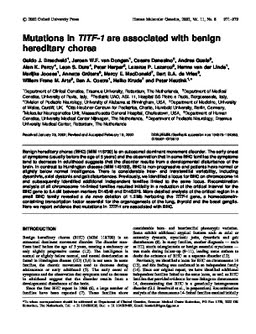
Benign hereditary chorea (BHC) (MIM 118700) is an autosomal dominant movement disorder. The early onset of symptoms (usually before the age of 5 years) and the observation that in some BHC families the symptoms tend to decrease in adulthood suggests that the disorder results from a developmental disturbance of the brain. In contrast to Huntington disease (MIM 143100), BHC is non-progressive and patients have normal or slightly below normal intelligence. There is considerable inter- and intrafamilial variability, including dysarthria, axial dystonia and gait disturbances. Previously, we identified a locus for BHC on chromosome 14 and subsequently identified additional independent families linked to the same locus. Recombination analysis of all chromosome 14-linked families resulted initially in a reduction of the critical interval for the BHC gene to 8.4 cM between markers D14S49 and D14S278. More detailed analysis of the critical region in a small BHC family revealed a de novo deletion of 1.2 Mb harboring the TITF-1 gene, a homeodomain-containing transcription factor essential for the organogenesis of the lung, thyroid and the basal ganglia. Here we report evidence that mutations in TITF-1 are associated with BHC.
| Additional Metadata | |
|---|---|
| , , , , , , , , , , , , , , , | |
| hdl.handle.net/1765/9889 | |
| Human Molecular Genetics | |
| Organisation | Erasmus MC: University Medical Center Rotterdam |
|
Breedveld, G., Guala, A., Oostra, B., Percy, A. K., Dure, L. S., Harper, P., … Heutink, P. (2002). Mutations in TITF-1 are associated with benign hereditary chorea. Human Molecular Genetics. Retrieved from http://hdl.handle.net/1765/9889 |
|