2006-12-01
The Optimal Use Of Fines And Imprisonment If Governments Don't Maximize Welfare
Publication
Publication
Journal of Public Economic Theory , Volume 8 - Issue 4 p. 677- 695
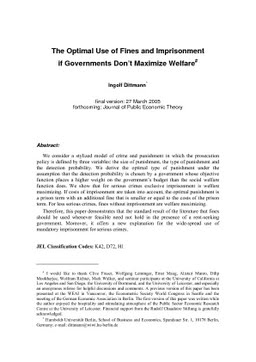
We consider a stylized model of crime and punishment in which the prosecution policy is defined by three variables: the size of punishment, the type of punishment and the detection probability. We derive the optimal type of punishment under the assumption that the detection probability is chosen by a government official whose objective function places a higher weight on the government's budget than the social welfare function does. We show that for serious crimes exclusive imprisonment is welfare maximizing. If costs of imprisonment are taken into account, the optimal punishment is a prison term with an additional fine that is smaller or equal to the costs of the prison term. For less serious crimes, fines without imprisonment are welfare maximizing. Therefore, this paper demonstrates that the standard result of the literature that fines should be used whenever feasible need not hold in the presence of agency conflicts. Moreover, it offers a new economic explanation for the wide-spread use of mandatory imprisonment for serious crimes.
| Additional Metadata | |
|---|---|
| , , , , | |
| , , | |
| doi.org/10.1111/j.1467-9779.2006.00283.x, hdl.handle.net/1765/11349 | |
| Journal of Public Economic Theory | |
| Organisation | Erasmus Research Institute of Management |
|
Dittmann, I. (2006). The Optimal Use Of Fines And Imprisonment If Governments Don't Maximize Welfare. Journal of Public Economic Theory, 8(4), 677–695.https://doi.org/10.1111/j.1467-9779.2006.00283.x |
|