2007
The Art and Craft of Budgeting: Fiscal Policy in the Eurozone
Publication
Publication
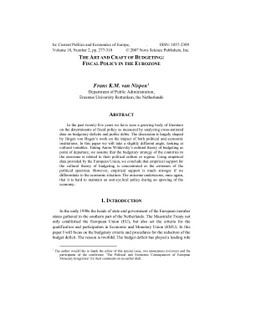
In the past twenty-five years we have seen a growing body of literature on the determinants of fiscal policy as measured by analyzing cross-national data on budgetary deficits and public debts. The discussion is largely shaped by Jürgen von Hagen’s work on the impact of both political and economic institutions. In this paper we will take a slightly different angle, looking at cultural variables. Taking Aaron Wildavsky’s cultural theory of budgeting as point of departure, we assume that the budgetary strategy of the countries in the eurozone is related to their political culture or regime. Using empirical data provided by the European Union, we conclude that empirical support for the cultural theory of budgeting is concentrated at the extremes of the political spectrum. However, empirical support is much stronger if we differentiate to the economic situation. The outcome underscores, once again, that it is hard to maintain an anti-cyclical policy during an upswing of the economy.
| Additional Metadata | |
|---|---|
| , , , , , | |
| Nova Science Publishers, Inc. | |
| hdl.handle.net/1765/11570 | |
| Organisation | Department of Public Administration |
|
van Nispen tot Pannerden, F. (2007). The Art and Craft of Budgeting: Fiscal Policy in the Eurozone.http://hdl.handle.net/1765/11570 |
|