1996-02-01
Do Policy Makers’ Distributional Desires Lead to an Inflationary Bias
Publication
Publication
Journal of Policy Modeling , Volume 18 - Issue 1 p. 109- 116
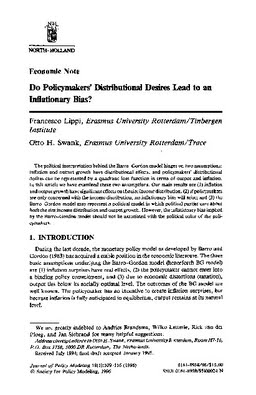
The political interpretation behind the Barro-Gordon model hinges on two assumptions: Inflation and output growth have distributional effects, and policymakers' distributional desires can be represented by a quadratic loss function in terms of output and inflation. In this article we have examined these two assumptions. Our main results are (1) inflation and output growth have significant effects on the size income distribution, (2) if policymakers are only concerned with the income distribution, no inflationary bias will arise; and (3) the Barro-Gordon model may represent a political model in which political parties care about both the size income distribution and output growth. However, the inflationary bias implied by the Barro-Gordon model should not be associated with the political color of the policymakers.
| Additional Metadata | |
|---|---|
| , , | |
| doi.org/10.1016/0161-8938(95)00024-0, hdl.handle.net/1765/12304 | |
| Journal of Policy Modeling | |
| Organisation | Erasmus School of Economics |
|
Lippi, F.& Swank, O. (1996). Do Policy Makers’ Distributional Desires Lead to an Inflationary Bias. Journal of Policy Modeling, 18(1), 109–116.https://doi.org/10.1016/0161-8938(95)00024-0 |
|