2007
Subjective measures of well--being
Publication
Publication
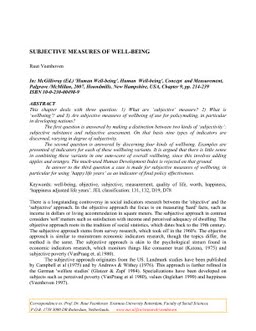
This chapter deals with three question: 1) What are ‘subjective’ measure? 2) What is ‘wellbeing’? and 3) Are subjective measures of wellbeing of use for policymaking, in particular in developing nations? The first question is answered by making a distinction between two kinds of ‘subjectivity’: subjective substance and subjective assessment. On that basis nine types of indicators are discerned, varying in degree of subjectivity. The second question is answered by discerning four kinds of wellbeing. Examples are presented of indicators for each of these wellbeing variants. It is argued that there is little sense in combining these variants in one sum-score of overall wellbeing, since this involves adding apples and oranges. The much-used Human Development Index is rejected on that ground. In answer to the third question a case is made for subjective measures of wellbeing, in particular for using ‘happy life years’ as an indicator of final policy effectiveness.
| Additional Metadata | |
|---|---|
| , , , , , , , , , | |
| hdl.handle.net/1765/12316 | |
| Organisation | Department of Sociology |
|
Veenhoven, R. (2007). Subjective measures of well--being.http://hdl.handle.net/1765/12316 |
|