1988
Evolution and mutagenesis of the mammalian excision repair gene ERCC-1
Publication
Publication
Nucleic Acids Research , Volume 16 p. 5305- 5322
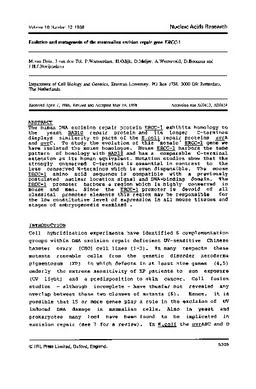
The human DNA excision repair protein ERCC-1 exhibits homology to the yeast RADIO repair protein and its longer C-terminus displays similarity to parts of the E.coli repair proteins uvrA and uvrC. To study the evolution of this 'mosaic' ERCC-1 gene we have isolated the mouse homologue. Mouse ERCC-1 harbors the same pattern of homology with RAD10 and has a comparable C-terminal extension as its human equivalent. Mutation studies show that the strongly conserved C-terminus is essential in contrast to the less conserved N-terminus which is even dispensible. The mouse ERCC-1 amino acid sequence is compatible with a previously postulated nuclear location signal and DNA-binding domain. The ERCC-1 promoter harbors a region which is highly conserved in mouse and man. Since the ERCC-1 promoter is devoid of all classical promoter elements this region may be responsible for the low constitutive level of expression in all mouse tissues and stages of embryogenesis examined.
| Additional Metadata | |
|---|---|
| , , , , , , , , , , , , , , , , , , , , , | |
| hdl.handle.net/1765/3002 | |
| Nucleic Acids Research | |
| Organisation | Erasmus MC: University Medical Center Rotterdam |
|
van Duin, M., van den Tol, J., Warmerdam, P., Odijk, H., Meijer, D., Westerveld, A., Bootsma, D.& Hoeijmakers, J. (1988). Evolution and mutagenesis of the mammalian excision repair gene ERCC-1. Nucleic Acids Research, 16, 5305–5322.http://hdl.handle.net/1765/3002 |
|