2014-06-03
Multimodality Imaging of the Long-term Vascular Responses Following Implantation of Metallic and Bioresorbable Devices
Publication
Publication
Multimodale beeldvorming van de vasculaire respons op de lange termijn na implantatie van metaalhoudende en bioresorbeerbare hulpmiddelen
Abstract
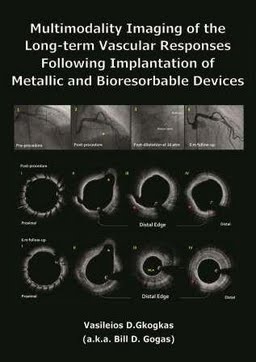
The pattern of vascular responses following stent/scaffold implantation in conventional interventional practice has been assessed by coronary angiography, intravascular ultrasound or optical coherence tomography and manifests as in-stent vascular response (focal or diffuse) or as edge vascular response (EVR) at the transition zones (focal). The utilization of bioresorbable scaffolds made of biodegradable polymers or biocorrodible metals for coronary revacularization has shown intermediate-term comparable in-scaffold restenosis rates with DES; however these devices need to prove their safety, efficacy and performance in larger randomized trials and broader clinical subsets. The EVR after implantation of a fully bioresorbable scaffold ABSORB BVS (Abbott Vascular, SC, Calif) at 1-year follow-up demonstrated some degree of proximal edge constrictive remodeling of -1,80% [-3.18; 1.30], (p<0.05) and distal edge increase of the fibro-fatty tissue component of 43,32% [-19,90; 244,28], (p<0.05) resulting in non-significant plaque progression with adaptive expansive remodeling. This morphological and tissue composition behavior did not significantly differ from the behavior of metallic drug-eluting stents at the same observational time points. At 2 –years follow-up a late lumen loss of 6,68% [-17,33; 2,08], (p=0.027) was observed with a trend towards plaque area increase of 7,55% [-4,68; 27,11], (p=0.06) while at the distal edge no major changes became evident. The observed significant proximal edge late lumen loss adjacent to the implanted fully resorbable scaffold at 2-years did not have any major clinical implications. The EVR with newer generation metallic stents and bioresorbable scaffolds is a cause of clinical restenosis in ≈ 3% and is more prevalent at the proximal edge. The previously observed “edge effect” (defined by angiography as diameter stenosis >50% at the proximal and/or distal edges) during the era of vascular brachytherapy has been replaced by the term EVR with the use of newer generation metal stents and bioresorbable scaffolds. Further improvements in stent design and materials of bioresorbable scaffolds are expected to reduce the incidence of proximal edge vascular response which despite is non-flow limiting is still visible at long-term with both sound- and light-based imaging modalities.
| Additional Metadata | |
|---|---|
| , , | |
| hdl.handle.net/1765/51452 | |
| Organisation | Erasmus MC: University Medical Center Rotterdam |
|
Multimodality Imaging of the Long-term Vascular Responses Following Implantation of Metallic and Bioresorbable Devices. (2014). Multimodality Imaging of the Long-term Vascular Responses Following Implantation of Metallic and Bioresorbable Devices.http://hdl.handle.net/1765/51452 |
|