2016-09-08
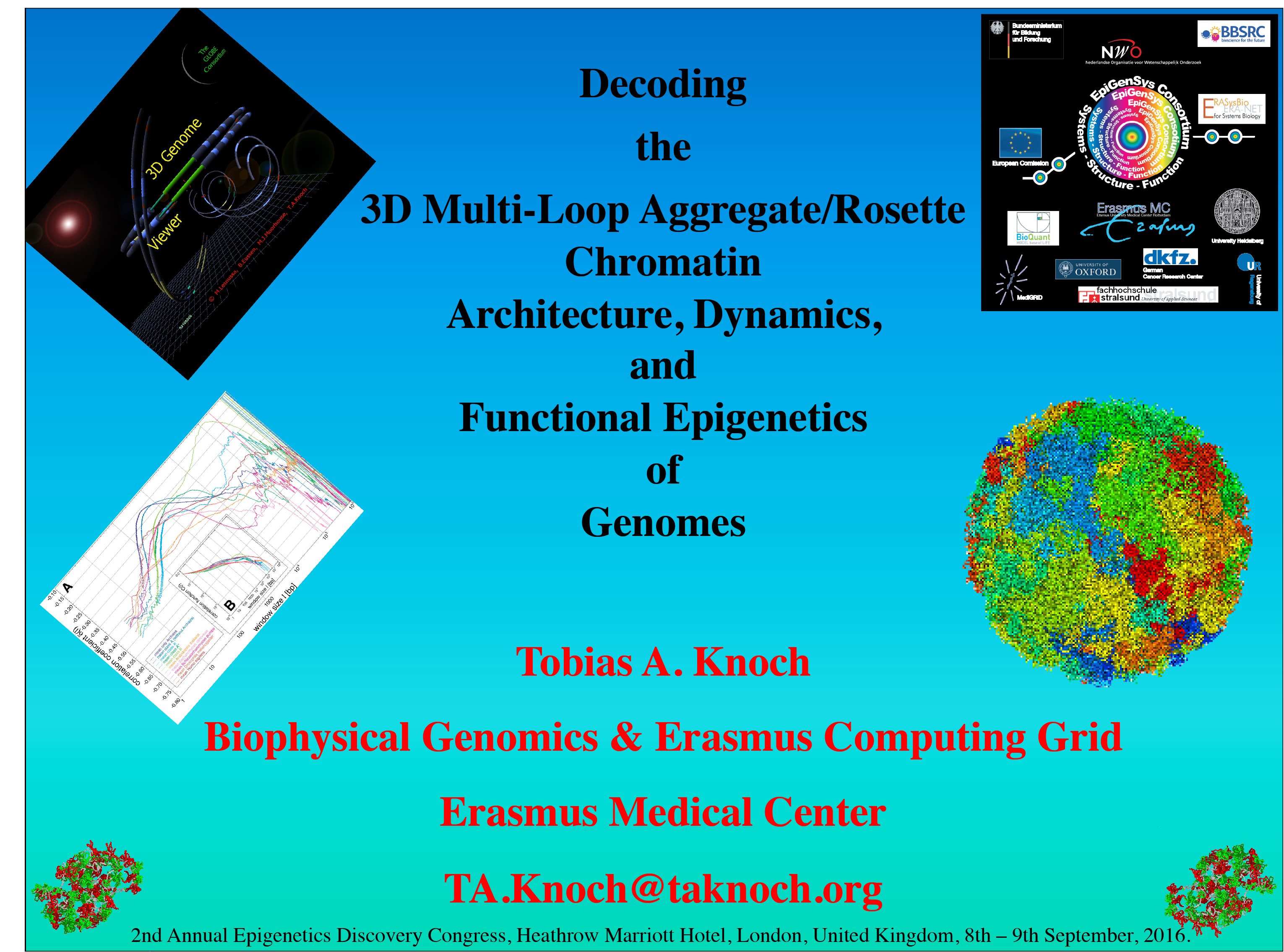
Decoding the 3D Multi-Loop Aggregate/Rosette chromatin architecture, dynamics, and functional epigenetics of genomes.
Publication
Publication
The dynamic three-dimensional chromatin architecture of genomes and the obvious co-evolutionary connection to its function – the storage and expression of genetic information – is still debated after ~170 years. With a systems genomics approach combining a novel selective high-throughput chromosomal interaction capture (T2C) with quantitative polymer simulations and scaling analysis of architecture and DNA sequence, we determined and cross-proved the final architecture of genomes with unprecedented molecular resolution and dynamic range from single base pairs to entire chromosomes: for a variety of genetic loci of different species, cell type, cell cycle, functional states and system distortion a chromatin quasi-fibre exists with 5±1 nucleosome per 11 nm, which folds into stable(!) 40-100 kbp loops forming stable(!) aggregates/rosettes which are connected by a ~50 kbp chromatin linker. Modifications on all these organizational levels are variations of the aforementioned scheme. Beyond, functional variations on various levels are reflected also on others. Spatial isotropy breaking is also found. Polymer simulations using Monte Carlo and Brownian dynamics approaches confirm this and predict and explain additional experimental findings. Beyond, a novel fluorescence correlation spectroscopy (FCS) approach combined with analytical polymer models measures the architectural dynamics in vivo in the entire genome and agrees with the before mentioned conclusion using completely independent means. System distortions are reflected in the corresponding variations as well. Beyond, we find a fine-structured multi-scaling behaviour of both the architecture and the DNA sequence, showing for the first time directly the tight entanglement between architecture and sequence. All this agrees with the outcome of a synopsis e.g. with previous spatial distance measurement studies, in vivo morphology of entire cell nuclei, or electron microscopy of chromosome spreading studies, as well as the heuristics of the field in the last 170 years. This now complete architecture and dynamics of these genomes has fundamental consequences for the entire system of the storage and expression of genetic information, for its investigation in general as well as for clinical epigenetics: E.g. this architecture, its dynamics, and accessibility balance stability and flexibility ensuring genome integrity and variation enabling gene expression/regulation by self-organization of (in)active units already in proximity. Thus, both the T2C and FCS approaches open the door to “architectural and dynamic sequencing” of genomes at a resolution where a genome mechanics with corresponding uncertainty principles applies. Consequently, this will lead now to a detailed understanding of genomes with fundamental new insights and huge novel perspectives for diagnosis, treatment and genome engineering efforts in the future.
| Additional Metadata | |
|---|---|
| , , , , , , , , , , , , , , , , , , , , , , , , , , , , , , , , , , , , , , , , , , , , , , , , , , , , , , , , , , , , , , , , , , , , , , , , , , , , , , , , , , , , , , , , , , , , , , , , , , , , , | |
| hdl.handle.net/1765/97701 | |
| 2nd Annual Epigenetics Discovery Congress, Heathrow Marriott Hotel, London, United Kingdom, 8th – 9th September, 2016. | |
| Organisation | Biophysical Genomics, Department Cell Biology & Genetics |
|
Knoch, T. (2016, September 8). Decoding the 3D Multi-Loop Aggregate/Rosette chromatin architecture, dynamics, and functional epigenetics of genomes. Presented at the 2nd Annual Epigenetics Discovery Congress, Heathrow Marriott Hotel, London, United Kingdom, 8th – 9th September, 2016. Retrieved from http://hdl.handle.net/1765/97701 |
|