2016-10-05
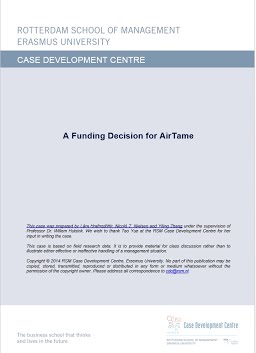
A Funding Decision for AirTame
Publication
Publication
AIRTAME was founded in 2013 in Copenhagen by a group of five Danish entrepreneurs. The product is a wireless screening device that can easily project or expand any computer’s screen to any other screen, even multiple ones at the same time, with only a few steps involved. The start-up successfully raised over US$1.2 million by means of crowdfunding. With this success, AIRTAME managed to sign partnerships with Jabil, a leading global manufacturer, and with important customers such as Microsoft, NASA, and Oxford University. By November 2014, AIRTAME had nearly drained its funds gained from crowdfunding and required additional capital. However, business angels were not convinced by its business plan and the company was not ready to attract venture capitalists. How should AIRTAME successfully apply for a second round of financing and gain the investment needed to further develop its product and expand globally? The case introduces students to the three main funding options: equity-based crowdfunding, angel investors, and venture capitalists. It compels students to compare the advantages and disadvantages of each funding option, with a focus on reward-based crowdfunding.
| Additional Metadata | |
|---|---|
| , , , , , , , , , , | |
| hdl.handle.net/1765/98041 | |
| RSM Case Development Centre | |
|
Based on field research; 12 pages. Follow the 'handle' link to access the Case Study on RePub. For EUR staff members: the Teaching Note is available on request, you can contact us at rsm.nl/cdc/contact/ For external users: follow the link to purchase the Case Study and the Teaching Note. |
|
| Organisation | Erasmus Research Institute of Management |
|
Hulsink, W., Hrafnsdóttir, L., Nielsen, N., & Zhang, Y. (2016). A Funding Decision for AirTame. RSM Case Development Centre. Retrieved from http://hdl.handle.net/1765/98041 |
|