2017-02-21
The Waning of the Radical Enlightenment in the Dutch Republic
Publication
Publication
When in 1784, on the eve of the German Pantheismusstreit, Friedrich Heinrich Jacobi wanted to know more about Dutch Spinozism, he asked his friend and correspondent Frans Hemsterhuis to send him a copy of Abraham Cuffeler’s Specimen artis ratiocinandi. This book had been published exactly one hundred years earlier by a lawyer who must have belonged to Spinoza’s circle of friends from The Hague. Jacobi was not very impressed, but to him Spinoza’s atheism presented a real threat to everything he held dear. For our purposes, the most revealing aspect of Hemsterhuis’s and Jacobi’s epistolary exchange must surely be the fact that apparently Hemsterhuis was unable to supply Jacobi with a more recent example of the way in which Spinoza had affected Dutch philosophy. A full century after its publication, Cuffeler’s Specimen must have become very rare indeed, and as far as we now know it left hardly any traces.
| Additional Metadata | |
|---|---|
| , , , , , | |
| hdl.handle.net/1765/98433 | |
| Organisation | Erasmus School of Philosophy |
|
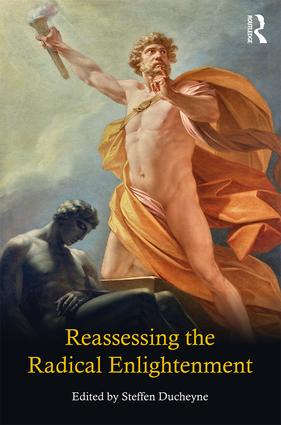
van Bunge, W. (2017). The Waning of the Radical Enlightenment in the Dutch Republic. In S. Ducheyne (ed.), Reassessing the Radical Enlightenment (London: Routledge, 2017) (pp. 178–193). Retrieved from http://hdl.handle.net/1765/98433 |
|