2016-11-01
Concordia Res Parvae Crescunt. The Context of Seventeenth-Century Dutch Radicalism
Publication
Publication
Any attempt to construct a context for the emergence of a particular idea or a ‘philosophy; let alone a philosophical ‘movement'.﹔ requires both geographical and chronological boundaries, defining the phenomenon in question as clearly as possible. In the case of the Radical Enlightenment, ’the Dutch Republic’ and 'the latter half of the seventeenth century' just won't do, but fortunately it is easy to be more precise: the first emergence of the Dutch Radical Enlightenment can be situated in the city of Amsterdam during the decade stretching from Spinoza’s ban from the Jewish community in 1656 to the anonymous appearance of Lodewijk Meyer's Philosophia S. Scripturae Interpres in 1666. By then all the relevant characters in Spinoza's ‘circle’ had made their mark.
| Additional Metadata | |
|---|---|
| , , , | |
| hdl.handle.net/1765/98435 | |
| Organisation | Erasmus School of Philosophy |
|
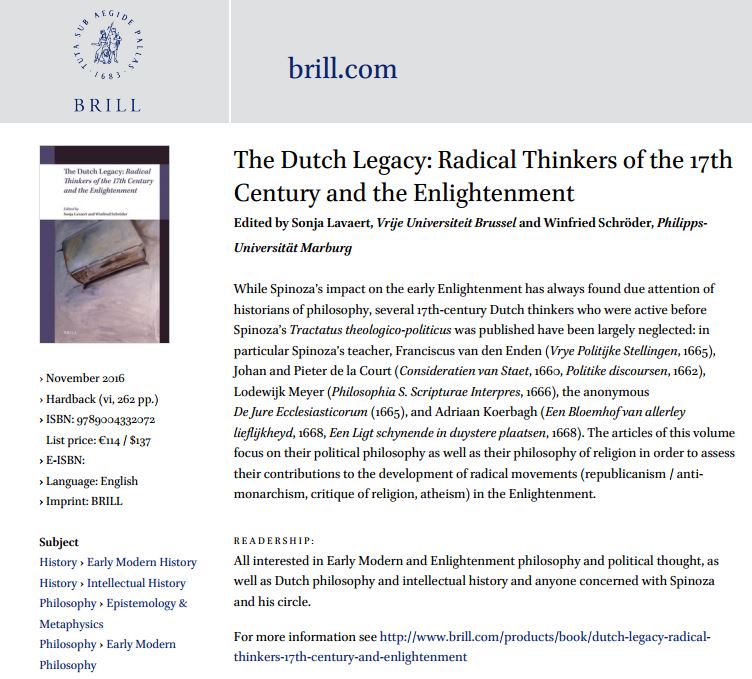
van Bunge, W. (2016). Concordia Res Parvae Crescunt. The Context of Seventeenth-Century Dutch Radicalism. In S. Lavaert & W. Schröder (eds) The Dutch Legacy: Radical Thinkers of the 17th Century and the Enlightenment. Brill, Leiden, 2017 (pp. 16–34). Retrieved from http://hdl.handle.net/1765/98435 |
|