2017-05-03
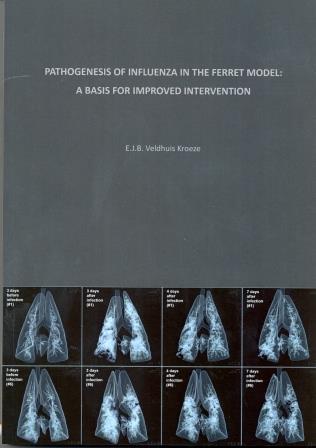
Pathogenesis of influenza in the Ferret Model : a basis for improved intervention
Publication
Publication
Pathogenese van influenza in het frettenmodel: een basis voor verbeterde interventie.
Although clinical disease and associated lesions of the respiratory tract due to IAV infections are well known, the exact pathogenesis of acute respiratory distress syndrome (ARDS) is not yet fully understood. ARDS is a fatal complication of influenza virus infection, and accounts for many influenza-‐related mortalities. At the starting point of this thesis, the mechanism of pulmonary oedema formation, as one of the hallmarks of influenza-‐induced ARDS, was unknown. Pulmonary oedema as a representative lesion of ARDS was of major interest in this thesis as it is an acute lesion that is easily detectable in histopathology. Several factors (cellular integrity, inflammatory cells, and cytokines) are known to influence the homeostasis of the alveolar epithelial-‐endothelial barrier (EEB) preventing or permitting oedema to develop. The obvious question that arose at the start of this thesis was: what is the mechanism by which influenza virus induces pulmonary oedema? Therefore the main aim of this thesis was unravelling the pathogenesis of influenza-‐induced ARDS and pulmonary oedema formation, to ultimately pinpoint the most significant pathogenic factors. A better understanding of the pathogenesis, especially identifying the most important causative pathogenic factors is essential in the development of new intervention strategies. Improved intervention options will likely reduce the recurrent global burden of seasonal influenza epidemics and pandemics.
| Additional Metadata | |
|---|---|
| , , , , , | |
| A.D.M.E. Osterhaus (Albert) , T. Kuiken (Thijs) | |
| Erasmus University Rotterdam | |
| This thesis is supported by: VIROCLINICS BIOSCIENCES B.V. | |
| hdl.handle.net/1765/99309 | |
| Organisation | Department of Virology |
|
Veldhuis Kroeze, E. (2017, May 3). Pathogenesis of influenza in the Ferret Model : a basis for improved intervention. Retrieved from http://hdl.handle.net/1765/99309 |
|
| Additional Files | |
|---|---|
| 4696_Veldhuis-Kroeze-Edwin-Johannes-Bertus.jpg Cover Image , 26kb | |
| Stellingen.pdf , 78kb | |