2011-12-21
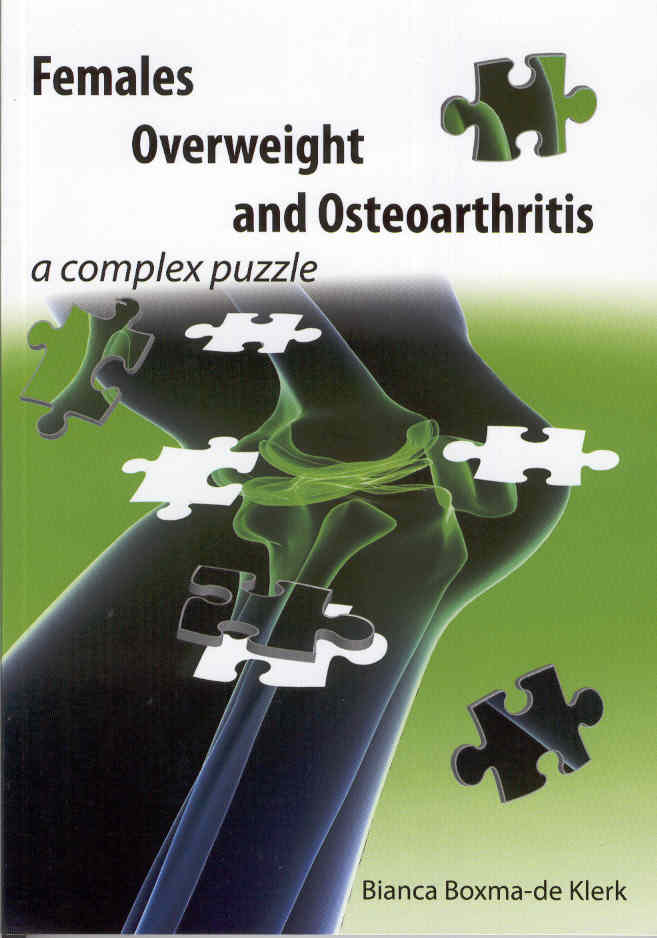
Females overweight and osteoarthritis : a complex puzzle
Publication
Publication
Vrouwen, overgewicht en artrose: een ingewikkelde puzzel
Every year many people consult their general practitioner (GP) for complaints related to the musculoskeletal system. Osteoarthritis (OA) is a common progressive joint disease causing pain and disability. This disorder is frequently experienced by middle-aged and older people [1] and generally affects hips, knees and hands. GPs are most often consulted for complaints of the hip and knee joint, with knee joint twice as often as the hip. In middle-aged and elderly people joint complaints are often thought to be caused by OA. With the increase in life expectancy and in the prevalence of obesity (both major risk factors for OA), the prevalence of OA will probably continue to rise [2, 3], as will the associated costs and burden for society. OA is a disease that affects the whole joint. Not only cartilage degenerates, but also subchondral bone thickens, osteophytes grow and the synovial membrane gets inflamed. All of these symptoms are associated with laxity and decreased muscle strength [4]. Current OA treatment is mainly symptom driven, since no cure is available. Pharmacological treatments commonly used for OA management are often outweighed by their undesired side-effects [5]. Also, disease modification is not yet possible because no effective treatments are currently available. Studies on disease-modifying interventions have had variable results. One problem with such interventions is that they are tested in populations already showing signs of clinically manifest OA. Treatment with disease-modifying interventions (such as losing weight, exercise therapy or early suppression of pain with medication) might be more effective in an earlier stage of the disease, i.e. in a pre-clinical stage. However, this possibility still needs to be investigated and confirmed in stages of the disease when no structural changes to the joint have occurred. At the moment it is not possible to determine in an early stage of the disease who will develop OA-related disability in a later stage. Also, it is impossible to identify which persons are at extremely high risk of OA development, or to select those persons already showing early signs of OA.
| Additional Metadata | |
|---|---|
| , | |
| Dutch Arthritis Association, Reumafonds, Stichting Anna Fonds (Leiden, The Netherlands), The Netherlands Organization for Scientific Research | |
| Erasmus MC: University Medical Center Rotterdam | |
| S.M. Bierma-Zeinstra (Sita) | |
| hdl.handle.net/1765/32157 | |
| Organisation | Erasmus MC: University Medical Center Rotterdam |
|
de Klerk, B. (2011, December 21). Females overweight and osteoarthritis : a complex puzzle. Retrieved from http://hdl.handle.net/1765/32157 |
|
| Additional Files | |
|---|---|
| Cover proefschrift BM Boxma-deKlerk.pdf , 817kb | |
| Stellingen BM Boxma-deKlerk.pdf , 416kb | |
| 3445_Boxma-de-Klerk-Bianca-Monique.jpg Cover Image , 45kb | |